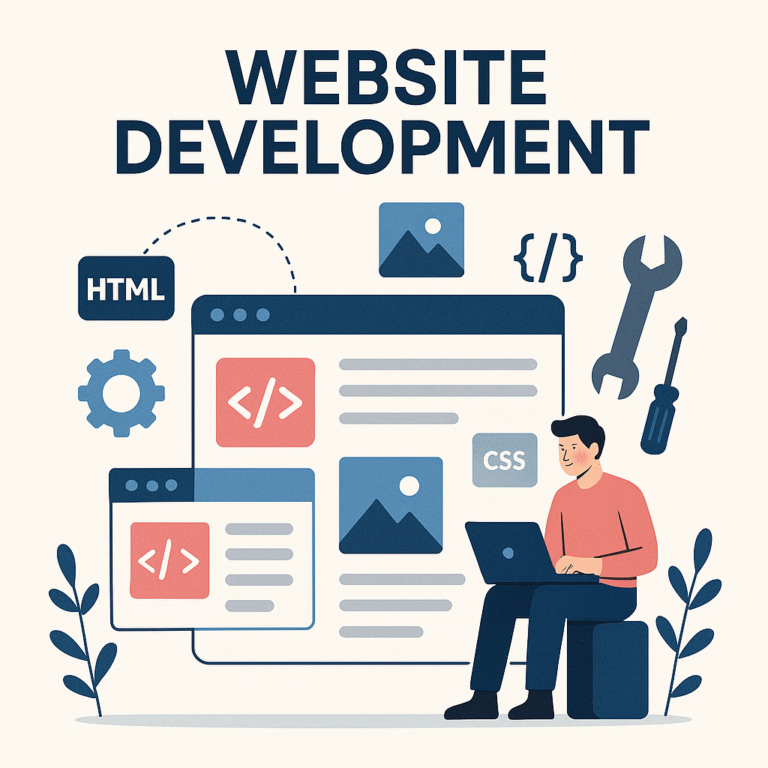
In Portugal, Corporate Web Design and Development indeed, have now come to prevail and serve as a bridge to inform customers as well as address their business needs. Trendily called State-Of-The-Art, the user interface and experience you seek in its design bear equal significance to performance and accessibility.
Having a functional aesthetic and fast website is not an option anymore for a startup in Lisbon, a boutique hotel in Porto, or a small business in Braga; it has become an essential aspect of your business strategy.
1. Why Web Design Matters in Portugal
For Portuguese businesses, a website is more than a digital business card — it’s your first impression, your conversion funnel, and often your primary marketing channel.
- Trust & Credibility: A slow or poorly designed website instantly creates frustration. In Portugal, mobile page load speeds average around 3.5 seconds, which already impacts user bounce rate.
- Accessibility: A significant portion of websites in Portugal still fail accessibility standards. Making your site readable and navigable for everyone isn’t just ethical — it expands your reach.
- Google Ranking: Search engines prioritize websites with fast loading times, mobile responsiveness, clear navigation, and semantic content — all directly influenced by good design and development.
2. Future Trends in Web Design for 2025 (Portugal Special)
a) Responsive and Mobile-First Design
Since most of the Portuguese people use their smartphones for browsing, it must be that your site performs and looks great on mobile devices. Fluid grids, flexible images, and CSS media queries have become mandatory.
b) Accessibility by Design
Designing for users who may have visual, motor, or cognitive impairments, for example, appropriate contrasts, keyboard-accessible, and screen reader accessible, can improve usability for all users — and aligns with SEO.
c) AI and Personalization
Artificial intelligence tools allow websites access to dynamic content to meet user behavior — e.g. recommending user-appropriate articles, products, or services. This is useful for the online retail industry, which is growing in Portugal, to help improve conversions.
d) Voice User Interfaces (VUI)
The rise of more tech-savvy phone users using the internet will increase reliance on voice search. Websites that offer voice navigation or have optimized content for the voice-based query have an advantage over competitors, specifically in the hospitality and tourism industry.
e) Sustainable Web Design
With more climate sensitivity in Portugal, more businesses are adopting environmentally sustainable practices with their digital practices like optimizing the performance of their websites to consume less energy, and working with environmentally-friendly web hosting providers.
3. The Portuguese Web Design Landscape
a) Talent is Everywhere — But Often Undervalued
Many Portuguese designers report that the local market expects them to be multi-skilled (UI, UX, branding, social media) while offering limited budgets. As a result, many professionals turn to freelance work for international clients.
b) Service-Driven Economy Demands Modern UX
With over 75% of Portugal’s GDP driven by services, businesses in tourism, health, education, and consulting increasingly seek modern, professional websites that generate leads or support digital transactions.
Steps to Creating a Great Website in Portugal
1. Strategy and Planning
Establish how you want to use your website and what goals your business has (sales, branding or lead generation), understand your customer types (local Portuguese people vs tourists), and plot the journey you want visitors to take.
2. UX and Storytelling
Design based on how users think – use clear navigation, highlight call-to-action entry points, and create a flow that moves visitors through progressively. Use story-telling visuals (videos, photos, case studies, etc.) that reference Portuguese values or culture.
3. Visual Design
Use clean layouts, readable fonts, and contrasting colors that are clear to see. Portuguese users like websites that create habits that are easy to follow and low in clutter (particularly for mobile use).
4. Development (Front End / Back End)
Use web frameworks that are lightweight with modular code, build with responsive architecture, and set your performance targets with a load time of 3 seconds or less. Some of the more common digital frameworks used in Portugal are WordPress, React, and Jamstack.
5. Optimising Performance
Utilise compression on media files, minify as much of your code as you can, and employ caching. Make sure your website is mobile responsive (mobile website load times are critical as mobile connections tend to be slower), and use lazy loading on your images.
6. Accessibility
Run screen-reader tests, run keyboard-only tests, use semantic HTML, ARIA labels, and use good contrasting colors.
7. SEO (Localized)
Identify the keywords you want to be positioning for in Portuguese, specific to your local area. Use a .pt domain, utilize local schema markup, and optimise for both textual search and voice search (look-up: “melhor restaurante em Lisboa”).
8. Security and Hosting
Apply SSL certificates.
5. Use Cases in the Portuguese Market
| Sector | Example Web Feature |
|---|---|
| E-commerce | Personalized product suggestions via AI |
| Tourism & Travel | Interactive maps, multilingual booking engines |
| Real Estate | AR tours and immersive galleries |
| Health & Wellness | Online booking, chat support |
| Education & Coaching | Course portals, email marketing integrations |
6. The Human Element Still Wins
Despite the rise of automation, Portuguese business owners and consumers still value authentic, local, and human experiences. As one designer said on a local forum:
“AI can automate layout, but creativity and cultural relevance can’t be faked.”
And another shared:
“Even without perfect English, my visual portfolio helped me get international clients — storytelling is universal.”
The takeaway? Build for people, not just machines.
7. Challenges in Portugal’s Web Design Market
- Low Budgets, High Expectations: Clients often want “full service” design (web, branding, SEO, marketing) with minimal investment.
- All-in-One Professionals Expected: Many businesses want a single person to handle development, UX, design, copywriting, and even ad campaigns.
- Limited Recognition of Creative Value: Designers are often undervalued locally, which drives a brain drain to international projects.
Still, this presents an opportunity: Portuguese designers and agencies who combine technical skill with clear strategy and human-centered design will stand out — both locally and abroad.